
A Linux administrator attempts to log in to a server over SSH as root and receives the following error message: Permission denied, please try again. The administrator is able to log in to the console of the server directly with root and confirms the password is correct. The administrator reviews the configuration of the SSH service and gets the following output: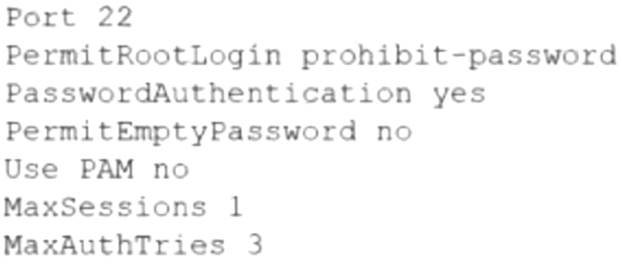
Based on the above output, which of the following will most likely allow the administrator to log in over SSH to the server?
Correct Answer:
D
The SSH configuration option PermitRootLogin prohibit-password prevents the root user from logging in with password authentication. This setting means root cannot use a password to log in via SSH; only key- based authentication is permitted for root. The administrator can still log in as root locally, which is not affected by this SSH configuration. To allow SSH access as root, the administrator must use an SSH key instead of a password.
Other options:
* A. MaxSessions controls the number of simultaneous SSH sessions but is not causing the login denial here.
* B. PAM (Pluggable Authentication Modules) is disabled, but enabling it is not required for basic SSH authentication.
* C. Changing the SSH port is unrelated to the authentication method issue.
Reference:
CompTIA Linux+ Study Guide: Exam XK0-006, Sybex, Chapter 11: "Securing Linux", Section: "Securing SSH Access"
CompTIA Linux+ XK0-006 Objectives, Domain 3.0: Security
A DevOps engineer needs to create a local Git repository. Which of the following commands should the engineer use?
Correct Answer:
A
Version control is a core DevOps practice, and CompTIA Linux+ V8 includes Git fundamentals as part of automation and orchestration objectives. To create a new local Git repository, the correct command is git init.
The git init command initializes a new Git repository in the current directory by creating a hidden .git directory. This directory contains all the metadata required for version control, including commit history, branches, configuration settings, and object storage. After running git init, the directory becomes a fully functional local repository ready to track files and commits.
The other options do not create a new repository. git clone is used to copy an existing remote repository to a local system, not to create a new one. git config is used to set Git configuration values such as username, email, or default editor. git add stages files for commit but only works after a repository has already been initialized.
Linux+ V8 documentation highlights git init as the foundational command for starting version control in new projects. This command is frequently used in DevOps workflows when creating infrastructure-as-code repositories, automation scripts, or application source trees from scratch.
By initializing a local repository, engineers can begin tracking changes, collaborating with others, and integrating Git into CI/CD pipelines. Therefore, the correct answer is A. git init.
An administrator set up a new user account called "test". However, the user is unable to change their
password. Given the following output:
Which of the following is the most likely cause of this issue?
Correct Answer:
A
For normal users to change their own password, /bin/passwd must have the SUID bit set (permissions should be -rwsr-xr-x). The SUID bit allows users to run the program with the permissions of the file owner (root), which is required to update /etc/shadow. The provided output shows /bin/passwd does not have the SUID bit (no 's' in the owner's execute field). As a result, user "test" receives an "Authentication token manipulation error". The password can be changed as root, which confirms it's a permissions/SUID issue.
Other options:
* B. If the password didn??t meet requirements, a different error would appear.
* C. There is no minimum day limit preventing password change (see chage -l output).
* D. The account and password are active (not disabled).
Reference:
CompTIA Linux+ Study Guide: Exam XK0-006, Sybex, Chapter 6: "User and Group Management", Section:
"Managing User Passwords and Policies"
CompTIA Linux+ XK0-006 Objectives, Domain 1.0: System Management
On a Kubernetes cluster, which of the following resources should be created in order to expose a port so it is publicly accessible on the internet?
Correct Answer:
C
Container orchestration concepts are part of the Automation and Orchestration domain in Linux+ V8. In Kubernetes, workloads run inside Pods, but Pods are not directly accessible from outside the cluster.
To expose an application externally, aServiceresource must be created. Services provide a stable network endpoint and can be configured as NodePort, LoadBalancer, or ClusterIP. Public exposure is typically achieved using NodePort or LoadBalancer types.
OptionC, Service, is correct. Deployments manage Pods, but they do not handle networking exposure. Pods represent running containers but lack external accessibility by default. "Network" is not a valid Kubernetes resource type.
Linux+ V8 documentation highlights Services as the mechanism for exposing containerized applications. Therefore, the correct answer isC.
A new drive was recently added to a Linux system. Using the environment and tokens provided, complete the following tasks:
• Create an appropriate device label.
• Format and create an ext4 file system on the new partition. The current working directory is /.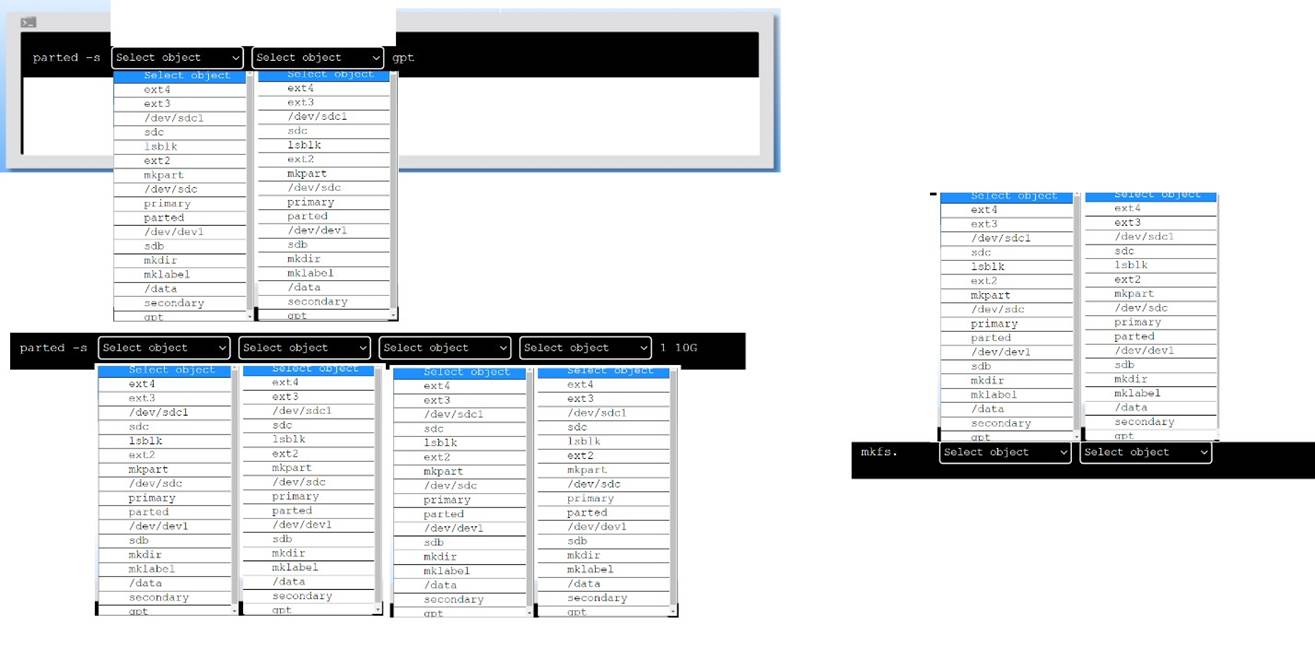
Solution:
To create an appropriate device label, format and create an ext4 file system on the new partition, you can use the following commands:
To create a GPT (GUID Partition Table) label on the new drive /dev/sdc, you can use the parted command with the -s option (for script mode), the device name (/dev/sdc), the mklabel command, and the label type (gpt). The command is:
parted -s /dev/sdc mklabel gpt
To create a primary partition of 10 GB on the new drive /dev/sdc, you can use the parted command with the -s option, the device name (/dev/sdc), the mkpart command, the partition type (primary), the file system type (ext4), and the start and end points of the partition (1 and 10G). The command is:
parted -s /dev/sdc mkpart primary ext4 1 10G
To format and create an ext4 file system on the new partition /dev/sdc1, you can use the mkfs command with the file system type (ext4) and the device name (/dev/sdc1). The command is:
mkfs.ext4 /dev/sdc1
You can verify that the new partition and file system have been created by using the lsblk command, which will list all block devices and their properties.
Does this meet the goal?
Correct Answer:
A